NEWS – 19.03.2026
Generative AI in Silberheim: A Battle Against Artificial Intelligence
Artificial Intelligence Is destroying the Gaming World - and Silberheim?
A plague is spreading across the world. It grows larger, stronger, consumes ever more resources, and destroys what humanity holds dear. Its name? Artificial Intelligence. That, more or less - admittedly exaggerated, yet not entirely unjustified - is the tone often found in reporting and comment sections whenever yet another overly polished asset appears in a game. Image-generating AI is seen as the enemy of art, of gaming, and of everything that has demanded human creativity for centuries. And because the topic is so polarizing and provokes so much resentment, we would like to offer our own perspective as game developers. After all, the reality - even that of Silberheim Evolving Card Game - is unfortunately more complex than a simple matter of black and white.
Where does the problem with generative AI in gaming lie?
It’s hard to imagine that anyone who has consumed news or used the internet in any form over the past three years could have missed the rapid advancement of artificial intelligence - alongside the growing criticism surrounding it. There is so much to complain about when it comes to AI that entire books could be written on the subject. Not least for that reason, we won’t attempt to cover everything here, nor will we try to define (generative) AI right from the outset. Instead, we’ll begin with a personal anecdote - one that nobody asked for.
Because in my (= Jana’s) final bachelor semester in 2023, I conducted an experiment as part of a research seminar. We wanted to find out whether news reports are perceived as less credible when AI-generated images are attached. “Of course that reduces credibility!” some of you are probably shouting while reading this. And naturally, that’s what we expected as well. Instead, however, something else emerged - something almost unsettling: the AI-generated images did not affect credibility any differently than “real” images. Why? Well, they were simply too good, and our participants just couldn’t tell that they were dealing with a fake.
Regardless of the fact that this was a university project rather than a large-scale study, this very issue is one of the key points of criticism when it comes to image-generating AI. And it is only one of many. It joins what feels like an endless list: AI hallucinates, it has biases, it consumes vast amounts of resources, its training data often disregards copyright - and perhaps using it even makes people less capable. Especially when we think about generative AI in gaming, there is also the community’s anger when money is charged for something that no human created through hours of effort and a great deal of creative work, but instead for something a machine has deemed most probable. People are (far more) willing to pay for an image that an artist has crafted by hand over many hours - a piece that aims to tell a story and is filled with meaning. But certainly not for some generated, washed-out thing with a yellow tint. And that is understandable. None of us is jumping for joy, throwing confetti and cutting cake when it comes to generative AI. Our Silberheim art team, in particular, has found in it a deeply disliked arch-nemesis.
The Silence oft the Managers
When one AI scandal after another sweeps through the gaming industry, and established, large studios choose machines over humans, anger and frustration are inevitable. What follows are apologies and explanations from the developers involved. It’s a reactive communication strategy that tries to keep things under wraps until, inconveniently, the truth comes to light and must be addressed. “Surely no one will notice that the character has six fingers and only four toes.
Is this the right way? The answer to this question depends on your perspective. If no one notices - great! Money saved, reputation intact. If someone does notice - bad. Money saved, reputation ruined. But there’s something else that gets ruined. And that’s trust. Not necessarily trust in individual games, franchises, or studios. Rather, it creates a general, frustrated skepticism toward any new game, as well as toward other forms of media. It’s not trust in the gaming industry itself that is lost, but trust in something that, for some, is a hobby, for others, a passion, for some, a pastime, for others, a refuge. For these “some” and “others,” this is not the right way.
Perhaps it is the right approach for studios that get away with it - keeping their use of AI hidden by staying silent. Perhaps it is a financially smart decision to hide it. But we should consider whether proactive honesty and transparency might offer an alternative: the beta version of Silberheim ECG uses AI-generated placeholders from Firefly*.
No - that is not the point where you should stop reading. This is not the moment to abandon the young team of a small, independent studio. You are listening now. Because this form of communication requires not only our honesty but also your trust. We want to do things differently. And to take the better - not necessarily the “right” - path, someone has to listen. If you grant us that initial trust, we promise you will not regret it. Our goal is to publish an article in a few months under the title: The Last AI Placeholder for the Release of Silberheim ECG Is Dead! So let’s take on the fight against artificial intelligence together. What you can do to help, we’ll explain at the end of this article. P.S.: Adobe’s AI, Firefly, was trained on licensed images from Adobe Stock as well as public domain content whose copyright protection has expired.
Show me the money!
The beta version of Silberheim ECG uses AI-generated placeholders - and that’s why you get to play it for free. To us, that’s only logical. On the one hand, this is a beta version where things can go wrong. That’s actually the point - finding bugs, reporting them, fixing them, and making the game better in the process. On the other hand, we have no intention of monetizing something that still relies so heavily on AI placeholders. In our view, we want to deliver first, convince you, and prove that we’re not completely incompetent - then we can celebrate the results. First do, then talk. That’s why we’ve created a beta version that won’t cost you anything. You can experiment as much as you like. No in-game purchases, no upfront price, no hidden anything. Just play and test - and we’ll be happy.
For some, this may sound admirable and idealistic, for others, irrational and economically unsound. And of course, the latter aren’t entirely wrong. Because while we are indeed very ambitious with our overall Silberheim endeavor, we are by no means reckless. So now, let’s actually talk about money and costs.
Developing a trading card game is, in some ways, something truly special. Most of the time, it’s something especially great. Sometimes, it’s something especially - WHAT WERE YOU THINKING THIS TIME, MANUEL?! Particularly problematic are the more than 1,000 cards that someone - unspecified, of course - on our team has come up with by now. The problem isn’t their design, but simply the fact that there are 1,000 of them. That’s 2,000 pieces of artwork! So the task is to replace 1,000 placeholder illustrations with something created by real people. Naturally, we’re getting closer to that goal day by day - but the sheer volume is definitely a challenge.
That’s why we collaborate with more than 20 different artists from around the world. In fact, only a small portion of our card illustrations are created in-house. What our art department actually does instead, we’ve already covered in another article. But even with the support of 20 additional pairs of hands, the sheer number of required illustrations remains a challenge. After all, good things take time - and an illustration isn’t created in just an afternoon. According to our Art Director, Hakim, it takes anywhere from 20 to 80 hours to complete a single piece of artwork. Those of you who are particularly quick thinkers might now say, “So, a week at most?!” Haha - no.
It takes 20 to 80 hours for an illustration to be completed. But there’s much more involved than just drawing. When we commission external artists, they first need to understand what Silberheim is all about and what we actually envision. Even the most talented artist can’t paint an Arak if they don’t know what an Arak is. So, to make sure all artists are on the same page, communication is essential: exchanging concepts, giving feedback after feedback, loop after loop - a constant back-and-forth between art direction and individual artists is what makes it possible for people on the other side of the world to create an Arak, a Glimmerwolf, or a Glenmor. You can probably imagine that this takes time - especially since we deliberately avoid using AI even in all preparatory work. And that preparation is a necessary time sink. Because the extra step is worth it. Anyone who wants to create a consistent and compelling fantasy world has to make sure every detail fits. That requires a great deal of groundwork and prior conceptual work on our part. We won’t go into worldbuilding, lore, or concept art here. But it should now be clear that producing the 1,000 illustrations we need is no small feat for a small team like ours. From the first message to an artist to the final illustration, one to two months can pass. Now multiply that by a thousand.
And that, dear readers, is the time dimension. But how much does it actually cost? How expensive is it to have one - or 1,000 - illustrations created by a real human being? Time for a déjà vu: according to our finance guy Manu, it costs around €500 to complete a single piece of artwork. Those of you who are particularly quick thinkers might now say, “So €500 times 1,000 illustrations?!” Haha - no.
It costs around €500 to have an artist create a single illustration. But that’s not the whole story. Most importantly, there are the personnel costs on our side for everything we described in the previous section: concept work, coordination, communication, and so on. In reality, an illustration is therefore much more expensive. Admittedly, it’s difficult to put an exact number on it. And admittedly, even the €500 is just a rough, illustrative figure - it varies from case to case and depends on many factors. So, for now, let’s state the bottom line: it will cost us at least half a million euros to have all cards illustrated by real artists. That’s essentially the price of two houses - invested in small, but beautiful card illustrations. And that’s without personnel costs. We are self-funded. Independent. But then again - that’s a choice we made.
And because this is a path we chose, we stand by it and want to keep pursuing this goal. However, in our current situation, it’s difficult to implement it immediately and all at once. By now, Silberheim supports 16 jobs that we want to protect. As for me, I definitely don’t want to leave :( A company - whether you like it or not - has to think economically. We simply don’t have a choice. Otherwise, it won’t be long before it’s over: for Silberheim, for Beyond Worlds, for our dream, our vision, all the stuff we’re building here - and with it, the 16 jobs we’ve created over time would be gone as well. That’s why we absolutely want to replace all placeholders as quickly as possible - but that “possible” depends on so many factors that we have to admit, somewhat frustrated, that we must ask both you and ourselves for patience.
One Hundred Fifty-Two Pieces of Evidence: Let Actions Speak Louder Than Words
Anyone can throw around big words. It’s easy to claim that we will eventually stop using AI-generated placeholders. We can say that as much as we want - but in the end, only what we actually do counts. That’s why we now want to let actions speak louder than words and simply show you an example.
Last summer, our alpha testing phase for Silberheim Evolving Card Game took place. A select group of testers devoted five weeks to an intensive examination of our game. This period was incredibly valuable for us and revealed various issues - which have now been completely eradicated! As a token of appreciation, the players received, among other things, the promo card “First Attempt.” Back then, in June 2025, this card still featured a placeholder. But now, it is adorned with a proper illustration by Joe Watson.
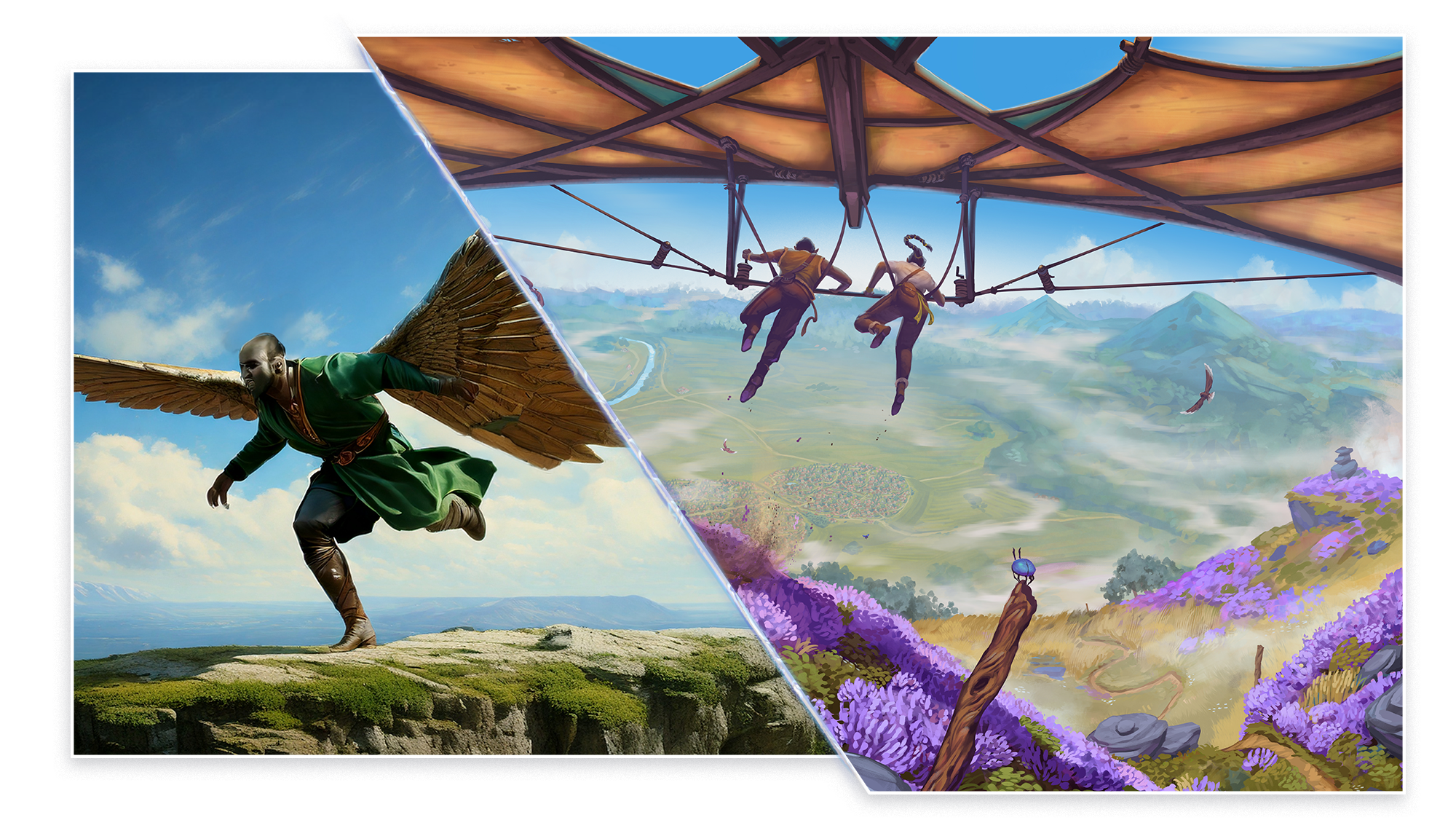
Well, I probably don’t need to emphasize which one is cooler.
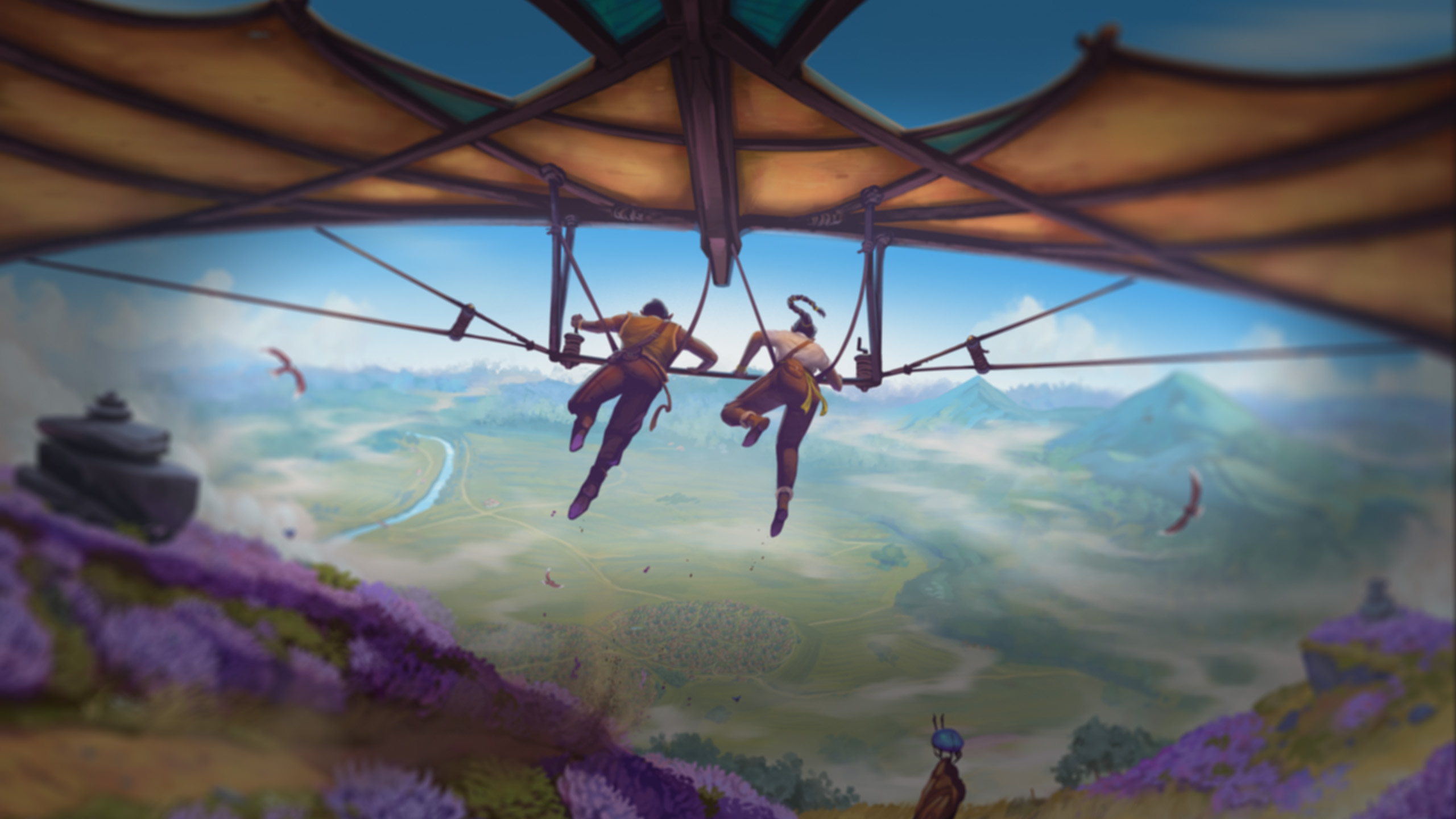
Joe Watson’s illustration shows two Fenn attempting their first flight down the Worldridge - recklessly carried by the wind toward a small town. This is Fennspring, a village in the far west of the Fenn Realm and the initial setting of our novel Daemonion. On the left, you can see a river, the Eimh. It rises from several sources in the Worldridge and makes its way to the Elendar. In Joe Watson’s illustration, it’s still at the beginning of its journey - a river that is relatively easy to cross. Around the two adventurous Fenn, a flock of birds accompanies them, guiding them hopefully safely downward. Their glider is designed in reference to a very specific bird of the Fenn Realm: the Arak! Decorated with reddish plumage, its blue accents can also be seen in the construction of the glider. And so they take off, on their mission to conquer the skies of Isdraia!
Yes, and on the AI-generated image, we had a guy who looked like he’d stolen a few feathers from the neighbor’s chickens and wasn’t quite sure whether he wanted to fly or just fall straight down.
But this story and contrast aren’t limited to the “First Try.” Since the alpha, we’ve replaced dozens (40+) of soulless placeholders with real illustrations. These join a growing list of over 150 pieces of artwork that have now been created for Silberheim by more than 20 international artists. And it’s really starting to gain momentum! Our art team is increasingly focused on eliminating AI-generated placeholders. By the time of the Steam release, there won’t be a single AI image left. That’s our goal, despite all circumstances -and we will do our best to achieve it. To make that possible, the art team has more than doubled compared to the alpha. Once, there were just three creative minds in the art department. Now, there are two art studios with a total of seven team members.
Do Your Part
Half a Bible, a whole - well, let’s leave that aside. You probably want to know what you can actually do to join us in the battle against generative AI. Maybe you’ve already forgotten again. Whatever it is, it’s really not difficult. It costs no money, and no baby seals will have to die - promise. You’ve already given us something even more valuable: your trust. Otherwise, you wouldn’t have made it this far. We truly appreciate that. Now, there’s just one more thing we ask: patience. Patience with us and our work, patience while we replace placeholder after placeholder. That’s all we need. And from the bottom of our hearts, we thank you